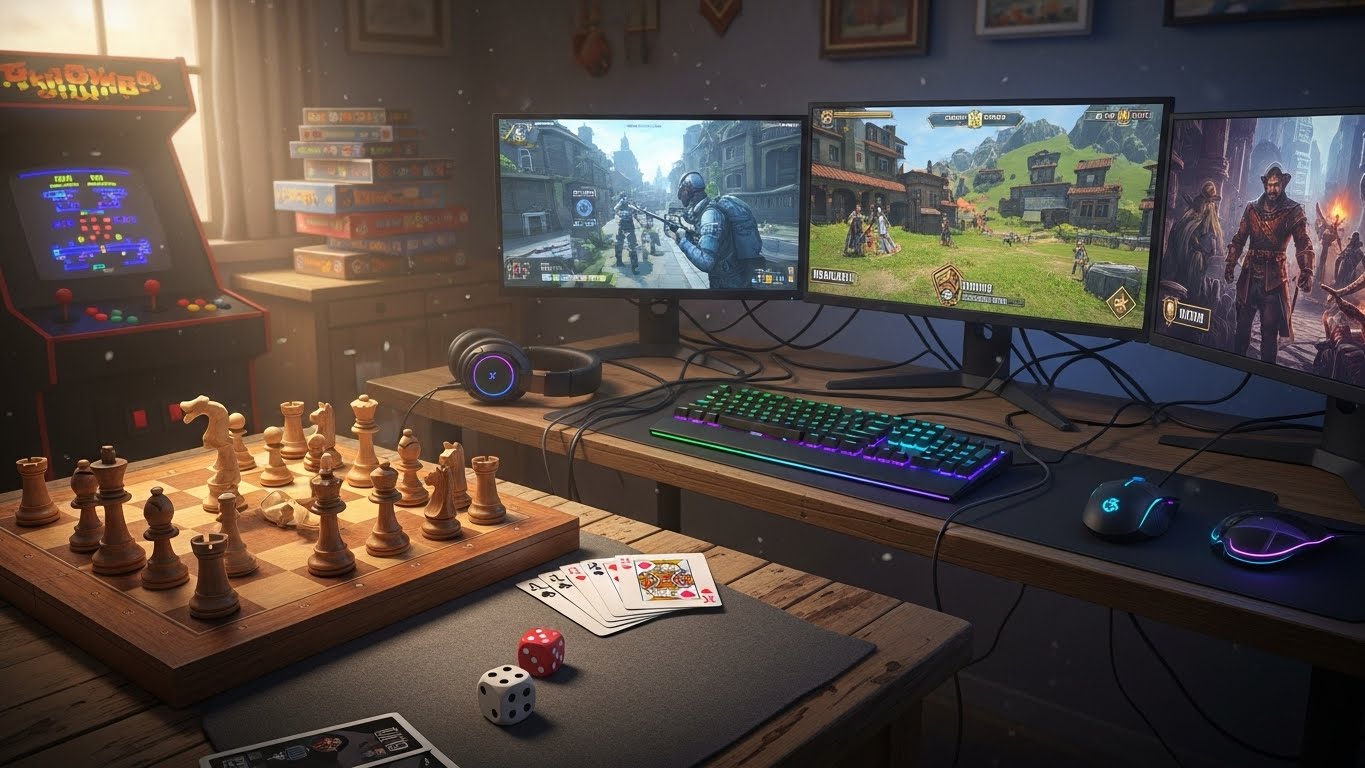


Gaming has come a long way since the days of simple pixelated graphics and limited gameplay. What was once a pastime for a select few has blossomed into a multi-billion-dollar industry, with millions of players across the world. Gaming has shifted from humble beginnings to become one of the most powerful forces in entertainment. The evolution of gaming is not just a story of technological progress; it is a story of cultural transformation, the development of new forms of storytelling, and the unification of a global community. This blog post will take you through the history, growth, and future of gaming, offering a comprehensive look at how video games have shaped the entertainment industry and what lies ahead.
The Birth of Video Games: The Dawn of Interactive Entertainment
The origins of video gaming trace back to the 1950s and 1960s, a time when the concept of video games was not yet formed but was starting to gain traction. The first known interactive video game was OXO, created in 1952 by A.S. Douglas. This was a digital version of Tic-Tac-Toe, created for a computer science project. While it was a basic game by today’s standards, it marked the beginning of something revolutionary: the idea that computers could be used for entertainment.
In 1958, William Higinbotham developed Tennis for Two, which was a simple tennis simulation displayed on an oscilloscope. While Tennis for Two was not widely distributed, it was the first game that allowed two people to play against each other in real-time, providing the framework for what would later become the foundation for video games.
However, the game that truly set the foundation for the video game industry was Pong, released by Atari in 1972. Pong was a simple two-player tennis simulation, but it was the first arcade game to achieve commercial success, sparking the video game craze that would soon follow. Pong became a cultural phenomenon and is often credited with giving birth to the video game industry.
The Rise of Home Consoles: Making Gaming Accessible
In the early 1970s and 1980s, gaming was primarily limited to arcades. While arcades provided a fun and social experience, they were not very accessible for people who wanted to play games at home. This changed with the introduction of home video game consoles. In 1977, Atari launched the Atari 2600, the first successful home console. The Atari 2600 allowed players to use cartridges to play a variety of games, a concept that would become the foundation for future consoles. While the Atari 2600 was not the first home console, it was the first to achieve widespread success, helping to pave the way for other consoles.
In 1985, Nintendo entered the home console market with the release of the Nintendo Entertainment System (NES). The NES was a game-changer, introducing a new level of sophistication to home gaming. Nintendo’s approach to game design, including colorful graphics, imaginative characters, and story-driven gameplay, helped elevate gaming from a simple pastime to an art form. Games like Super Mario Bros., The Legend of Zelda, and Metroid became household names and established Nintendo as one of the most important companies in the gaming industry.
Nintendo’s success was followed by the Sega Genesis, released in 1988. Sega brought in its own unique flavor with games like Sonic the Hedgehog and Altered Beast, while also challenging Nintendo for dominance in the 16-bit era. The rivalry between Sega and Nintendo in the 1990s, often referred to as the “console wars,” was a defining moment in the industry. Both companies pushed the boundaries of what home consoles could do, and this rivalry spurred innovation in graphics, sound, and gameplay.
The 3D Revolution: PlayStation and the End of 2D Gaming
The 1990s ushered in a new era of gaming with the introduction of 3D graphics. While earlier consoles were capable of 2D gameplay, the development of 3D technology allowed developers to create more expansive and immersive worlds. The first major player in the 3D revolution was Sony, with the release of the PlayStation in 1994.
The Sony PlayStation was the first console to fully embrace 3D gaming, and its success was immediate. The PlayStation was able to create fully realized 3D environments, enabling developers to design complex worlds that players could explore in new ways. Games like Gran Turismo, Crash Bandicoot, and Final Fantasy VII showcased the power of 3D technology and set new standards for storytelling and game design. The PlayStation became a massive success, breaking sales records and creating a new gaming culture.
At the same time, Nintendo also released the Nintendo 64 in 1996, further cementing 3D gaming as the future of the industry. The Nintendo 64 featured classic titles such as Super Mario 64, The Legend of Zelda: Ocarina of Time, and GoldenEye 007, all of which demonstrated the capabilities of 3D gameplay. Super Mario 64 in particular became a landmark title, influencing not only platformers but also the way developers approached 3D game design.
With the release of the PlayStation and Nintendo 64, the world of gaming shifted dramatically. 2D games, while still popular, were quickly overshadowed by the possibilities offered by 3D graphics. The 3D revolution also marked the beginning of more cinematic storytelling in games, with developers incorporating deeper narratives and more complex character development.
Online Gaming: The Rise of Multiplayer and the Internet
The 2000s marked a major shift in gaming, as the internet became an integral part of the gaming experience. While early console games were mostly single-player or local multiplayer experiences, the rise of broadband internet connectivity opened the door to online multiplayer gaming. Online gaming allowed players to compete or cooperate with others around the world, making gaming a much more social and dynamic experience.
One of the most influential online games of the early 2000s was World of Warcraft, a massively multiplayer online role-playing game (MMORPG) released in 2004. World of Warcraft allowed players to immerse themselves in a persistent online world, complete quests, join guilds, and engage in player-versus-player combat. The game became a cultural phenomenon, with millions of players worldwide and a thriving online community.
At the same time, consoles began incorporating online services. Microsoft’s Xbox Live, which launched in 2002, allowed Xbox players to connect with others for multiplayer matches, chat, and share content. Sony followed suit with the PlayStation Network, which launched in 2006, enabling PlayStation users to engage in online gaming.
Online gaming also gave rise to competitive gaming and esports. Games like Counter-Strike, League of Legends, and Dota 2 became staples of the competitive gaming scene. Esports tournaments began attracting massive audiences, both online and in person, and professional gamers became celebrities in their own right. The rapid growth of esports turned competitive gaming into a multi-billion-dollar industry, with sponsorships, endorsement deals, and large-scale tournaments offering players lucrative careers.
The Era of Mobile Gaming: Gaming Everywhere
In the late 2000s, the rise of smartphones and tablets brought about another shift in the gaming landscape: mobile gaming. Mobile games offered accessibility and convenience, allowing players to game on the go. With the introduction of the iPhone in 2007 and the subsequent rise of app stores, mobile gaming became more popular than ever.
Mobile gaming is one of the most significant shifts in the gaming industry. Games like Angry Birds, Clash of Clans, and Candy Crush Saga became global sensations, offering quick, easy-to-play experiences that appealed to casual gamers. Free-to-play models with in-app purchases became the norm, allowing developers to create games that players could download and enjoy for free, while monetizing through microtransactions.
While mobile games are often associated with casual gaming, mobile platforms have also supported more complex titles. Games like Monument Valley, PUBG Mobile, and Fortnite demonstrated that smartphones could handle high-quality gaming experiences. Mobile gaming has become the largest segment of the gaming industry, surpassing both console and PC gaming in terms of revenue.
The Next Frontier: Virtual Reality and Augmented Reality
As gaming technology continues to advance, two areas that are poised to revolutionize the gaming experience are virtual reality (VR) and augmented reality (AR). These technologies promise to take immersion in gaming to new heights, offering players experiences that go beyond what traditional screens and controllers can provide.
Virtual reality offers an entirely new way of experiencing games by immersing players in 3D environments that they can interact with using VR headsets and motion controllers. VR games allow players to feel as if they are actually inside the game world, whether they are exploring alien planets, solving puzzles, or fighting off enemies. The Oculus Rift, HTC Vive, and PlayStation VR are just a few examples of VR systems that are pushing the boundaries of gaming.
Augmented reality, on the other hand, blends the virtual and physical worlds. Games like Pokémon GO use AR technology to overlay digital objects onto the real world. As AR technology continues to improve, it has the potential to create entirely new gaming experiences that combine real-world interaction with digital gameplay.
Both VR and AR are still in their early stages, but as the technology continues to evolve, they will likely become integral parts of the gaming landscape. The potential for more immersive, interactive, and creative gaming experiences is immense, and the possibilities are virtually limitless.
The Future of Gaming: Where We’re Headed
The future of gaming is as exciting as it is uncertain. As technology continues to advance, new trends and innovations will continue to shape the gaming landscape. Cloud gaming, which allows players to stream games directly from the internet without the need for expensive hardware, is already starting to gain traction with services like Google Stadia and Xbox Cloud Gaming.
Artificial intelligence (AI) is another area that will likely transform the gaming industry. AI could enhance non-playable characters (NPCs), making them more responsive and intelligent, creating a more dynamic and unpredictable gaming experience. AI could also help in game design, enabling developers to create vast, procedurally generated worlds that offer nearly infinite gameplay possibilities.
The gaming industry is also becoming increasingly diverse, with more inclusive and representative content emerging. Video games are now telling a broader range of stories, featuring diverse characters and exploring a wide variety of cultures, perspectives, and experiences. The gaming community itself is becoming more inclusive, with players of all ages, genders, and backgrounds coming together to enjoy games.
As technology continues to evolve, gaming will remain at the forefront of entertainment, constantly pushing the boundaries of what is possible and offering new, exciting ways to experience stories, competition, and adventure.
Conclusion: Gaming’s Enduring Impact
From the simple beginnings of Pong to the immersive virtual worlds of today, gaming has evolved into an industry that shapes culture, connects people, and provides entertainment in ways never before imagined. Whether through home consoles, mobile devices, online multiplayer experiences, or the emerging realms of virtual and augmented reality, gaming has become an integral part of modern life.
As we look to the future, the possibilities for gaming are endless. The industry will continue to grow, innovate, and captivate players across the world. Gaming is no longer just a pastime—it is a global phenomenon that will only continue to evolve in ways that we can’t yet fully comprehend. The next chapter in the story of gaming is just beginning, and it promises to be as exciting and transformative as the ones that came before.